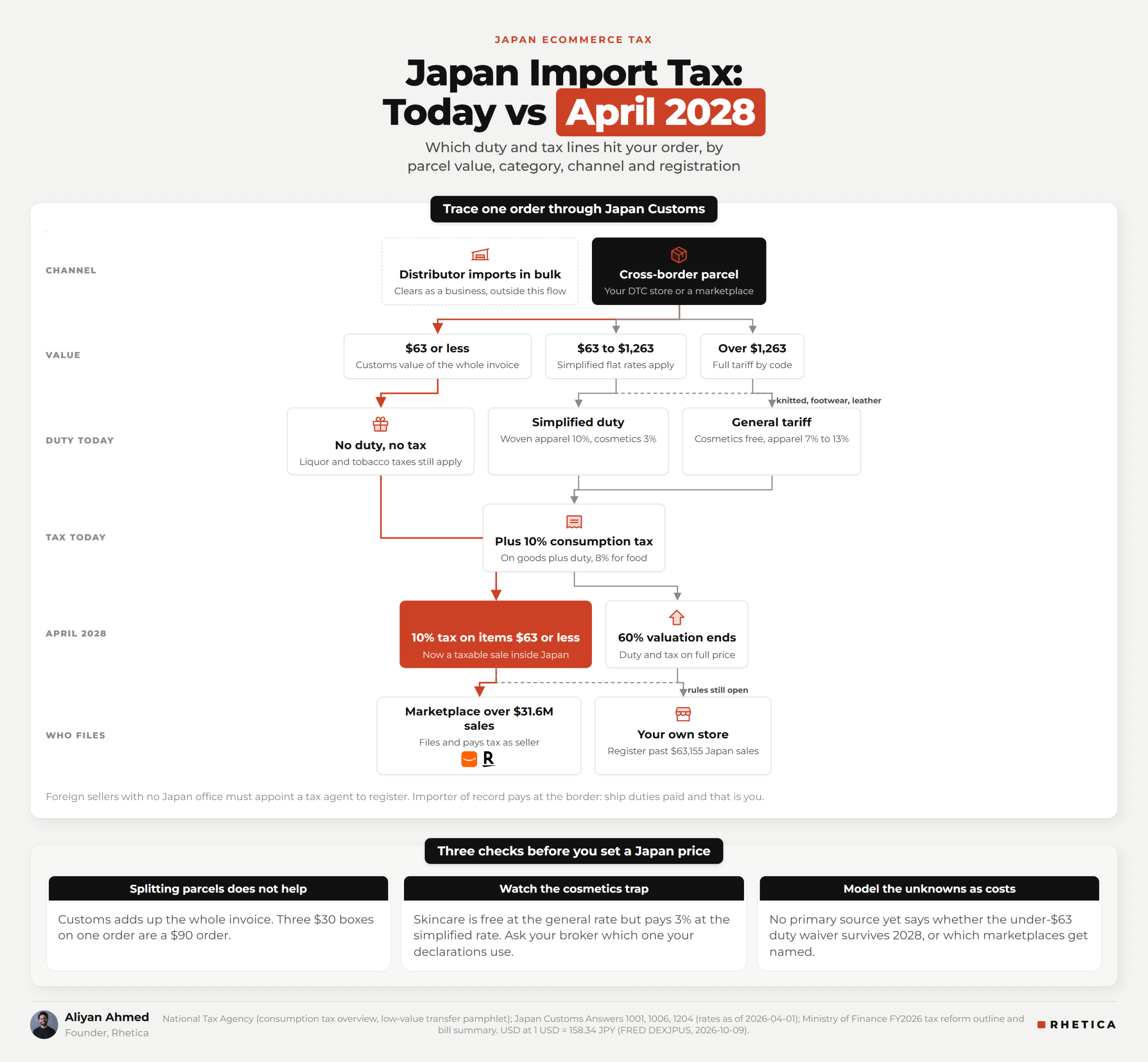
Japan charges a 10% consumption tax on imports, plus customs duty that depends on the product. Cosmetics are duty free at the general rate; most apparel pays about 7% to 13%. Parcels worth about $63 or less skip both today. From April 1, 2028, low-value sales become taxable, so price for the tax now.
The change hits small, frequent orders hardest. In fiscal 2024, Japan Customs handled about 190 million import permits, and roughly 90% were for goods worth about $63 or less (Ministry of Finance, March 2026).
The first-market mistakes checklist: the errors that sink a first international market, and how to spot them before you spend.
Get the checklistRhetica is a B2B international-expansion and DTC growth consultancy that builds and operates new-market revenue. Tax is one line in the full cost of entering Japan, and it is the line that changes most by 2028.
What import taxes does a Japanese order pay today?
Most orders pay two lines. Customs duty depends on the product’s tariff code, and consumption tax runs 10% on the goods plus duty, or 8% for food (National Tax Agency).
Small parcels are the exception. If the total customs value on a declaration is about $63 or less, Japan waives both duty and import consumption tax (Japan Customs, Customs Answer 1006). This is Japan’s low-value import exemption, its version of de minimis. Liquor and tobacco taxes still apply. Splitting one invoice into several parcels does not help, because Customs adds up the whole invoice.
Mid-size parcels get simpler rates. For parcels up to about $1,263, Japan uses flat rates instead of the full tariff (Japan Customs, Customs Answer 1001). Apparel that is not knitted pays 10%, and cosmetics pay 3%. Knitted clothing, footwear and leather goods are left out of this list and pay the general rate.
Personal imports get one more break today. Customs values them at about 60% of the overseas retail price, so duty and tax land on a smaller base (Ministry of Finance).
The importer of record pays at the border. Ship with duties paid and that is you. Ship without, and your customer gets the bill at the door.
What changes on April 1, 2028?
Three rules change on the same day. The low-value break ends for consumption tax, the 60% personal-use valuation ends, and large marketplaces start filing tax for foreign sellers.
Under the FY2026 tax reform, a sale shipped into Japan where one item costs about $63 or less before tax becomes a taxable sale inside Japan (National Tax Agency). The NTA calls these specified low-value asset transfers. Today the same goods enter tax free.
The 60% valuation for personal imports also ends that day (Ministry of Finance bill summary). After that, duty and tax use the full price. The ministry said over 90% of goods using the old rule were worth about $63 or less (MOF Finance).
Japan will also name large marketplaces as second-type platform operators. A marketplace qualifies when the sales it collects in a tax period top about $31.6 million, tax included (NTA pamphlet). It then files and pays consumption tax as if it were the seller. That covers goods foreign businesses sell in Japan and low-value sales by any business.
Two points are still open. Primary sources do not yet say whether the duty waiver for parcels under about $63 survives 2028, or which marketplaces will be named. Model both as unknowns, not as savings.
How much customs duty does your product category pay?
It depends on the tariff code and the parcel size. Cosmetics are duty free at the general rate, Japan’s customs duty on clothing runs roughly 7% to 13%, and supplements need a code-by-code check.
| Product | General rate | Simplified rate (parcels up to about $1,263) | Source |
|---|---|---|---|
| Woven coats, jackets, trousers, skirts | 8.4% to 12.8% | 10% if not knitted | Customs |
| Shirts and vests | 7.4% to 10.9% | 10% if not knitted | Customs |
| Swimwear | 8.4% to 10.9% | 10% if not knitted | Customs |
| Knitted clothing | Full tariff, by code | Not eligible | Customs |
| Perfume, lipstick, skin lotion, bath soap | Free | 3% | Customs |
| Supplements | Confirm the exact code | Confirm with your broker | Customs |
Watch the cosmetics row. A skincare parcel can be duty free at the general rate yet pay 3% under the simplified rate. Ask your broker which one your declarations use.
Supplements sit in a food tariff code with import licenses and food-law checks attached. The published rate columns are easy to misread, so confirm the code and paperwork before the first shipment.
Do I need to register for JCT as a foreign seller?
Not until your taxable sales in Japan pass about $63,155 in the base period. For a company, that is the business year two years back (National Tax Agency). You also become taxable if sales or salaries pass that line in the first six months of the prior year.
Foreign businesses with no office in Japan must appoint a tax agent. That is a real cost line, so budget for it before you register.
Where your stock sits matters. Ship from abroad with the customer as importer, and today’s tax is settled at the border. Stock goods in a Japan warehouse, and those become sales inside Japan that count toward the threshold. The trade-off is laid out in shipping from home versus using a Japan 3PL.
After April 2028, low-value sales count as sales inside Japan too. Published guidance does not yet say whether a small direct seller under the threshold avoids registration. Sell through a named marketplace and it files for you.
How should you price for Japan’s import tax now?
Treat tax as a contribution margin line, not a checkout surprise. Japanese shoppers see tax-included prices, so decide now whether you raise prices in 2028 or absorb the cost.
Take a $40 serum with a 30% contribution margin, shipped one item per parcel. Today it ships under the low-value line, so no consumption tax applies. From April 2028, the 10% tax applies. Keep the $40 price and absorb it, and you keep about $36.36 per order.
Your margin falls from $12 to about $8.36, or about 23% of what you keep. That drops below the 25% contribution margin line Rhetica uses for a green market. This is why you need contribution margin by country, not one global number.
Raise the price to $44 and the margin holds. Then conversion has to absorb a 10% price increase.
Keep tax out of your acquisition math. True CAC is your fully loaded cost to win one customer in one market: media, agency fees, creative, influencers and launch discounts, divided by net new customers. Tax belongs in margin, where it sets how many orders it takes to earn that cost back. The full method is in how to calculate True CAC in a new market.
When founders call Japan hard, they usually mean margin came in thinner than they modeled. Import tax is one of those specific lines. I have launched 30+ DTC brands into new markets, and when I model Japan, I put the 2028 tax into the price test on day one. A price you raise later costs you the customers you already won.
When this does not apply
If most of your items sell well above about $63, you already pay duty and tax at the border, and 2028 changes little beyond the end of the 60% personal-use valuation. Brands selling through a Japanese distributor that imports in bulk also sit outside this, because the distributor clears customs as a business. Liquor, tobacco and regulated foods follow their own rules. If you sell software, Japan taxes foreign digital services under separate rules, including platform taxation since April 2025.
Next: 4 Ways to Enter Japan in 2026: Cross-Border, Marketplace, Distributor or Your Own KK, because the channel you pick decides who files this tax after 2028.
If Japan is already on your list, apply for an Expansion Review.
Frequently asked questions
What import taxes apply when I sell to Japanese customers from abroad?
Japan charges a 10% consumption tax on the goods plus duty, or 8% for food, and customs duty that depends on the product code. Most apparel pays about 7% to 13% at the general rate, while cosmetics are duty free. Parcels with a customs value of about $63 or less are exempt from both today, but that changes for consumption tax on April 1, 2028.
Is Japan ending its de minimis exemption in 2028?
Yes, for consumption tax. Under the FY2026 tax reform, sales shipped into Japan where one item costs about $63 or less before tax become taxable sales inside Japan from April 1, 2028. The personal-use valuation at about 60% of retail price also ends that day. Official sources have not yet confirmed whether the customs duty waiver for small parcels continues.
Do I need to register for Japanese consumption tax as a foreign seller?
Registration becomes required once your taxable sales in Japan pass about $63,155 in the base period, which for a company is the business year two years earlier. Sales or salaries above that line in the first six months of the prior year also trigger it. Foreign sellers with no office in Japan must appoint a tax agent. Goods stocked in a Japan warehouse count as sales inside Japan.
Will marketplaces collect Japanese consumption tax for foreign sellers?
From April 1, 2028, Japan will name large marketplaces as second-type platform operators. A marketplace qualifies when the sales it collects in a tax period top about $31.6 million, tax included. It then files and pays consumption tax as the seller for goods sold in Japan by foreign businesses and for low-value sales. Japan has not yet announced which marketplaces will be named.
What is the customs duty on clothing imported into Japan?
At the general rate, woven coats, jackets and trousers pay 8.4% to 12.8%, and shirts pay 7.4% to 10.9%. Parcels worth up to about $1,263 can use a simplified flat rate of 10% for clothing that is not knitted. Knitted clothing and footwear are excluded from the simplified rates, so the full tariff applies. Consumption tax of 10% is added on top.
The first-market mistakes checklist: the errors that sink a first international market, and how to spot them before you spend.
Get the checklist