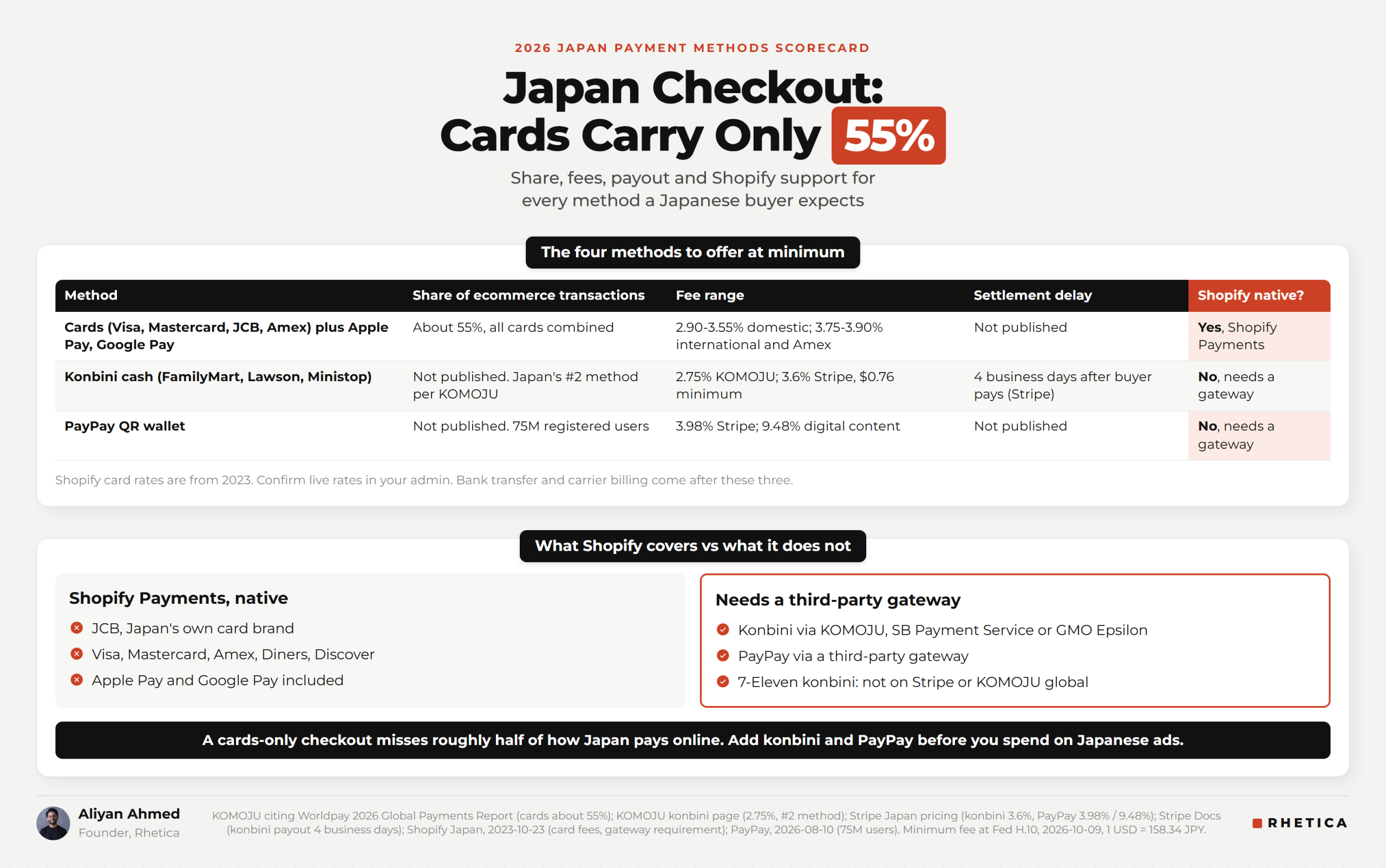
To sell online in Japan, offer cards with JCB, konbini (convenience store) payment, PayPay and Apple Pay at minimum. Cards carry only about 55% of Japanese ecommerce transactions. Konbini and PayPay have needed a gateway beyond Shopify Payments. If you sell only on Amazon or Rakuten, the marketplace handles payment instead.
Payment is one layer of the Japan ecommerce stack for foreign brands, and it is the layer I check first. In my work with 30+ DTC brands launched into new markets, a missing local method has hurt sales more than weak demand. Rhetica is a B2B international-expansion and DTC growth consultancy that builds and operates new-market revenue. Below are four pass or fail checks to run before you spend on Japanese ads.
Get a Green, Yellow, or Red verdict on your next market in 5 minutes. Free, online, no call required.
Run the Margin DiagnosticHow do Japanese shoppers pay online?
Japanese shoppers pay online with cards first, but cards carry only about 55% of ecommerce transactions (Source: KOMOJU, citing the Worldpay 2026 Global Payments Report). The rest goes to konbini cash, QR wallets like PayPay, bank transfer and carrier billing.
National data shows the same habit. In 2025, 58.0% of all Japanese consumer payments were cashless, counting stores and online together (Source: METI, 2026-03-31).
Inside that cashless spend, credit cards took 82.7% and QR code payments took 10.2% (Source: Impress Watch on METI data). That covers all retail, so read it as habit, not as your checkout mix.
The habit is what counts. A shopper who paid at a FamilyMart yesterday expects that option on your store today. The ways Japanese shoppers buy online differ from US buyers in many places, but payment is where a ready buyer leaves without saying why.
Does your checkout take JCB, Apple Pay and Google Pay?
Pass if your checkout takes Visa, Mastercard, JCB and Amex, plus Apple Pay and Google Pay. Fail if JCB is missing, because JCB is Japan’s own card brand.
Shopify Payments works in Japan. It takes cards, accelerated checkouts and what it calls local payment methods (Source: Shopify Help Center). Its Japan card list includes JCB, Diners and Discover, and Apple Pay and Google Pay come included.
Shopify’s Japan blog listed domestic card fees of 2.90% to 3.55% by plan. International cards and Amex ran 3.75% to 3.90% (Source: Shopify Japan, 2023-10-23). Those rates are from 2023. Confirm them in your admin before you build your contribution margin by country.
Cards are the base layer. They are not the whole checkout.
Can a buyer pay cash at a konbini?
Pass if a buyer can pick konbini, get a payment number, and pay cash at FamilyMart, Lawson or Ministop within a few days. KOMOJU calls konbini Japan’s second-largest payment method (Source: KOMOJU konbini page).
Shopify konbini payment has run through a gateway such as KOMOJU, SB Payment Service or GMO Epsilon (Source: Shopify Japan, 2023). Shopify’s help page does not name its local methods today, so test the live checkout.
Fees differ by provider. KOMOJU charges 2.75% per konbini payment (Source: KOMOJU). Stripe Japan charges 3.6% with a $0.76 minimum fee, and it needs a Japanese Stripe account (Source: Stripe Japan pricing).
Four facts shape the setup.
- 7-Eleven is out. Stripe does not cover it, and KOMOJU blocks it for global merchants.
- The window is short. KOMOJU lets you set 1 to 59 days, with a 3-day default (Source: KOMOJU Help Center). The order number voids after the last day.
- No chargebacks. Stripe says konbini payments are not open to disputes, and it pays out 4 business days after the buyer pays (Source: Stripe Docs).
- There is a cap. Stripe limits one konbini payment to $1,895.
For SaaS or subscriptions, konbini cannot bill on a schedule. Lead with cards and keep konbini for one-off orders.
Is PayPay on your checkout?
Pass if PayPay shows as its own button at checkout. PayPay has 75 million registered users as of August 2026 (Source: PayPay, 2026-08-10).
PayPay processed 8.88 billion transactions in 2025. That was more than 20% of all cashless transactions in Japan, across every method (Source: PayPay).
PayPay for online stores costs 3.98% per transaction on Stripe Japan, or 9.48% for digital content (Source: Stripe Japan pricing). On Shopify, PayPay has needed a third-party gateway (Source: Shopify Japan, 2023).
Bank transfer and carrier billing come after that. Add them once cards, konbini and PayPay are live and you can see which buyers still drop.
Can a stranger in Japan pay you in under 90 seconds?
Pass if a first-time Japanese buyer can pay in under 90 seconds with the method they used yesterday. The Checkout Diagnostic is Rhetica’s test of whether a stranger in a new market can pay you that fast.
The rule is to fix payment before you touch ad spend, then fix pricing, then language. In markets we have traced, payment-step completion sat at 80.7% against 92.7% elsewhere, and the gap came from a missing local method. That 12-point gap is checkout abandonment you already paid to create.
Run the test on a phone, as a Japanese buyer, with a timer. Then weigh fees against lost sales.
Take a Japan store doing $1 million a year. Say konbini and PayPay pull 30% of its sales onto methods that cost about 0.5 points more than cards. The extra fees come to $1,500 a year. If the change wins back 2% of revenue, that is $20,000 in sales.
Use one rule. Add a method when the revenue it wins back beats its fee gap on the volume that moves. Here, break-even is 0.15% of revenue.
This is why checkout kills more international revenue than weak demand. When the gap is a missing method, more ad spend only sends more buyers to a checkout they cannot use.
When this does not apply
This checklist assumes you own the checkout on your own store. If you sell only on Amazon Japan or Rakuten, the marketplace runs payment and none of these checks are yours to fix. It also flips for content-led products where the language is the product, so translation comes first. B2B buyers who pay by invoice need bank transfer before konbini or PayPay.
Konbini, PayPay and card fees all land in your margin, so check Japan against the gate before you add spend. Run the Rhetica Margin Diagnostic. It takes five minutes, pulls your CAC, payback and returns by market into one view, and flags which market fails the gate.
Frequently asked questions
What is konbini payment for ecommerce?
Konbini payment lets a Japanese shopper order online, get a payment number, and pay cash at a convenience store such as FamilyMart, Lawson or Ministop. The order ships after payment. KOMOJU calls it Japan’s second-largest payment method. Foreign brands add it through a gateway such as KOMOJU or Stripe Japan, and 7-Eleven is not available to global merchants on those gateways.
Does Shopify support konbini and PayPay in Japan?
Shopify Payments works in Japan for cards, including JCB, plus Apple Pay and Google Pay. Its help page mentions local payment methods without naming them. Konbini, PayPay and carrier billing have run through third-party gateways such as KOMOJU, SB Payment Service or GMO Epsilon. Test your live checkout as a Japanese buyer to see which methods actually appear.
How many people use PayPay in Japan?
PayPay reported 75 million registered users as of August 2026. It processed 8.88 billion transactions in 2025, which was more than 20% of all cashless transactions in Japan across every payment method. For an online store selling to Japanese consumers, that reach makes PayPay one of the first methods to add after cards and konbini.
How do Japanese pay online?
Japanese shoppers pay online mostly by credit card, but cards carry only about 55% of ecommerce transactions, according to Worldpay data cited by the payment provider KOMOJU. The rest goes to konbini cash payment, QR wallets such as PayPay, bank transfer and carrier billing. A store that offers only cards serves just over half of the payment habits it will meet.
Why do shoppers abandon checkout in Japan?
A common cause is a missing local payment method. A shopper who expects konbini or PayPay sees only card fields and leaves. Rhetica’s Checkout Diagnostic tests whether a first-time buyer can pay in under 90 seconds with the method they used yesterday. If the answer is no, fix payment before raising ad spend, then fix pricing, then language.