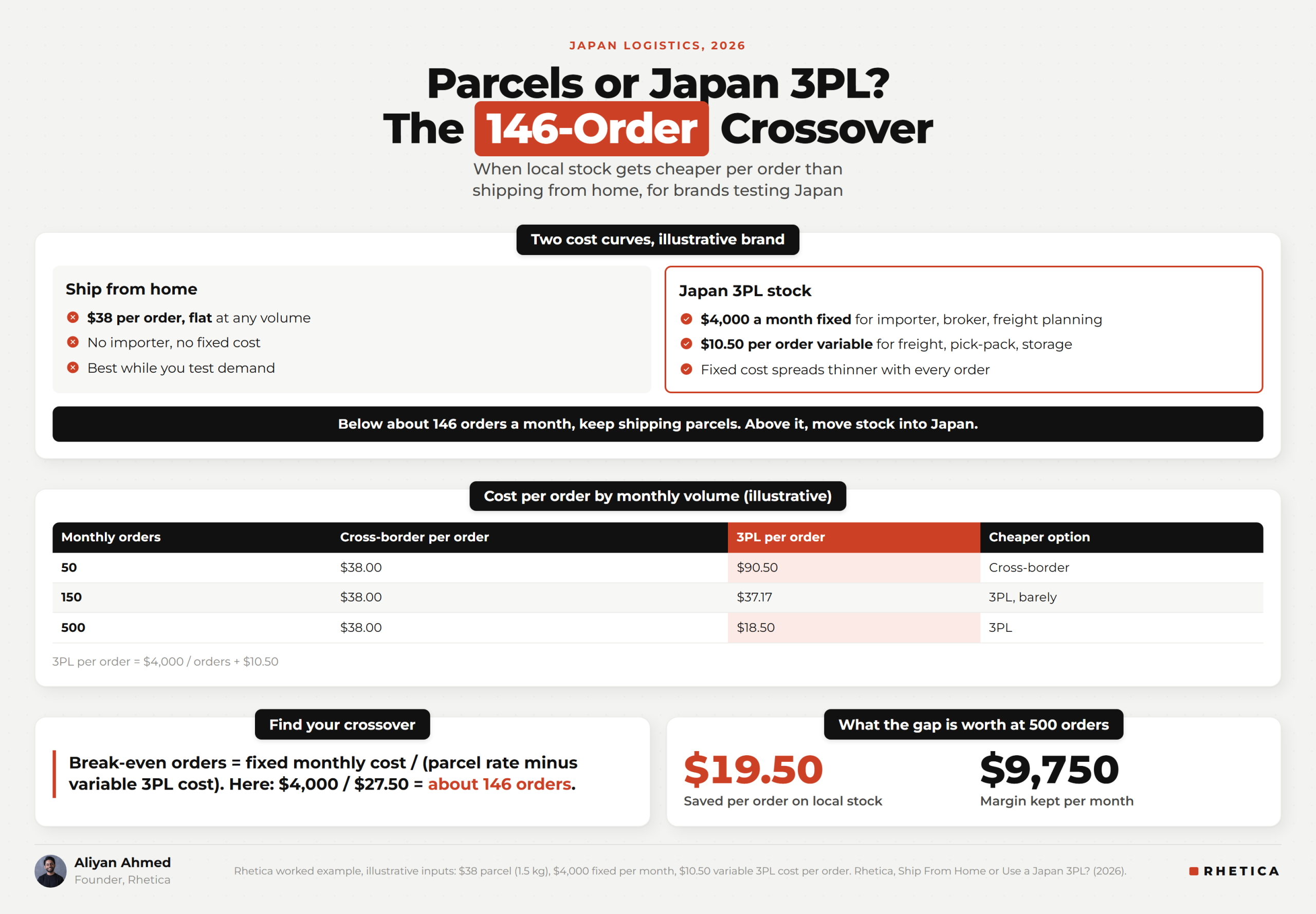
Ship to Japan from home while you test demand. Move stock into a Japanese 3PL once your monthly orders make international parcels cost more per order than bulk freight, local fulfillment and a fixed importer setup. Local stock also delivers faster. The exception is a very light or low-volume product, where parcels stay cheaper.
The crossover is a single volume number, and you can work it out in ten minutes. Logistics is one layer of the Japan ecommerce stack for foreign brands, and it moves contribution margin more than most teams expect. Rhetica is a B2B international-expansion and DTC growth consultancy that builds and operates new-market revenue.
Get a Green, Yellow, or Red verdict on your next market in 5 minutes. Free, online, no call required.
Run the Margin DiagnosticHow do you calculate the break-even between shipping from home and a Japan 3PL?
Divide your fixed monthly Japan costs by what you save on each order when it ships from local stock. The result is the monthly order count where both options cost the same.
Three short formulas do the work:
- Cross-border cost per order = your international parcel rate.
- 3PL cost per order = (fixed monthly cost / orders) + freight per unit + pick-pack-ship + storage per order.
- Break-even orders per month = fixed monthly cost / (parcel rate minus variable 3PL cost per order).
The fixed line covers the import side. That means a Customs Procedure Agent or importer partner, a customs broker, freight planning and any warehouse minimum. Some Japanese 3PLs charge nothing fixed. OPENLOGI, for example, bills only per use for inbound, storage and shipping, with no setup fee (Source: OPENLOGI pricing). So most of your fixed cost sits in importing, not in the warehouse.
For the variable line, use a published floor. Amazon.co.jp charges $2.01 to $3.36 per standard-size unit to pick, pack and deliver items priced above about $6.30, tax included (Source: Amazon Japan seller pricing). Storage runs about $0.036 per liter per month from January to September, and $0.064 from October to December (Source: Amazon Japan seller pricing).
Independent 3PLs do not publish rate cards. OPENLOGI quotes only after it reviews your logistics profile, so treat the FBA numbers as a floor, not a quote.
For the parcel rate, pull your real weight from the carrier’s own calculator. USPS puts Japan in Price Group 17 for its Priority Mail International services (Source: USPS IMM, Japan). Do not use a blog average.
Where do the lines cross at 50, 150 and 500 orders a month?
In this worked example, the lines cross at about 146 orders a month. Below that, parcels are cheaper. Above it, the 3PL wins, and the gap keeps growing with every order.
Take a brand paying $38 to ship a 1.5 kg parcel to Japan. Its fixed Japan cost is $4,000 a month. The variable 3PL cost is $10.50 per order: $4 for freight and broker fees per unit, $6 for pick-pack and domestic delivery, and $0.50 for storage. The $6 sits above the FBA benchmark on purpose, to stay conservative.
| Monthly orders | Cross-border per order | 3PL per order | Cheaper option |
|---|---|---|---|
| 50 | $38.00 | $90.50 | Cross-border |
| 150 | $38.00 | $37.17 | 3PL, barely |
| 500 | $38.00 | $18.50 | 3PL |
The break-even is $4,000 / ($38 minus $10.50), which is $4,000 / $27.50, or about 146 orders. At 500 orders, local stock saves $19.50 per order, or $9,750 a month. That is margin you keep, not revenue you need to win.
At 50 orders, a 3PL would more than double your cost per order. That is why testing cross-border first makes sense.
What do you need before stock can sit in Japan?
You need someone in Japan who can import for you. A foreign company filing its own import declarations must name a Customs Procedure Agent with a Japanese address and tell customs in advance (Source: Japan Customs FAQ 9601).
The notice goes in two copies of Customs Form C No.7500. It must attach a proxy or contract, proof that your company exists, proof that the agent exists, and a chart of how the goods and money flow (Source: Japan Customs FAQ 9601). In practice, a customs broker files the declaration for you (Source: Japan Customs import summary).
The paperwork got stricter recently. Since October 2023, importer name and address are required on every declaration. Since October 12, 2025, declarations also ask about the EC platform and where goods go after import (Source: Baker McKenzie).
Many 3PLs work with a partner that can act as your agent. Ask before you sign. Duty and consumption tax apply either way, and the rules differ by route; theJapan import duty and consumption tax guide for ecommerce covers both. If your product ships as freight, not parcels, local stock pays off far sooner. The playbook forshipping heavy and bulky goods to Japan walks through those routes.
What changes the answer?
Three inputs move the crossover most: parcel weight, fixed import cost and the conversion you gain from faster delivery. Re-run the formula whenever one of them shifts.
Weight. A heavier parcel raises your saving per order and pulls the crossover down. In the example, a $48 parcel drops the break-even to about 107 orders.
Speed. USPS says Priority Mail Express International reaches many major markets in 3 to 5 business days, and customs can add delays (Source: USPS). From local stock, parcels ride domestic networks like Yamato’s, which covers 100% of Japan and carried about 2.3 billion parcels in the fiscal year ended March 2025, a 47.2% share (Source: Yamato Holdings). Japanese shoppers expect fast, precise delivery, as the guide to how Japanese shoppers buy online explains.
True CAC. True CAC is Rhetica’s fully loaded cost to win one customer in a market: paid media, agency fees, creative, influencer spend and launch discounts, divided by net new customers. Across Rhetica client launches, True CAC in months 1 to 6 ran well above the home ad-spend-only number, and the True CAC method for international markets shows how to build it. Slow delivery hurts conversion, and lower conversion raises True CAC. That cost never shows up in a shipping quote.
In my work with 30+ DTC brands personally launched into new markets, I build this formula before the first pallet ships, not after.
When this does not apply
Skip this model if you sell only on Amazon.co.jp, because FBA already makes the warehouse choice for you. It also breaks for made-to-order goods that cannot sit as stock. If a distributor imports and holds your inventory, the importer and 3PL steps are theirs, not yours. And a very light product at a few dozen orders a month should simply keep shipping parcels.
Once you know your crossover volume, check whether Japan clears the margin gate at that volume. Run the Rhetica Margin Diagnostic. It takes five minutes, pulls your CAC, payback and returns by market into one view, and flags which market fails the gate.
Frequently asked questions
Do I need an importer of record to sell in Japan?
If you hold stock in Japan, yes. A foreign company filing its own import declarations must name a Customs Procedure Agent with a Japanese address and notify customs in advance on Form C-7500. In practice a customs broker files the declaration. Many Japanese 3PLs work with a partner that can act as your agent, so ask before you sign.
How much does a Japan 3PL cost per order?
Independent Japanese 3PLs rarely publish rates and quote after reviewing your logistics profile. The best public floor is Amazon.co.jp FBA, which charges about $2.01 to $3.36 per standard-size unit to pick, pack and deliver items priced above about $6.30, tax included. Add freight, broker fees and storage per unit to get your full variable cost.
How long does shipping from the US to Japan take?
USPS says Priority Mail Express International reaches many major markets in 3 to 5 business days, and customs inspection can add delays. Stock held in a Japanese warehouse ships on domestic networks such as Yamato, which covers all of Japan. Japanese shoppers expect fast, precise delivery, so local stock usually converts better than cross-border parcels.
At what order volume should I move stock to a Japan 3PL?
Move stock when your monthly orders pass the break-even volume. Calculate it as fixed monthly Japan costs divided by your parcel rate minus the variable 3PL cost per order. With a $38 parcel, $4,000 fixed and $10.50 variable, the crossover is about 146 orders a month. Use your own carrier rate and 3PL quote.
Can Amazon FBA Japan replace a Japan 3PL?
For Amazon.co.jp sales, FBA handles picking, packing, delivery, customer service and returns, so it replaces a separate warehouse there. It does not cover orders from your own Japanese store unless you set up multi-channel fulfillment. You still need a way to import the goods, which means a Customs Procedure Agent or importer partner.