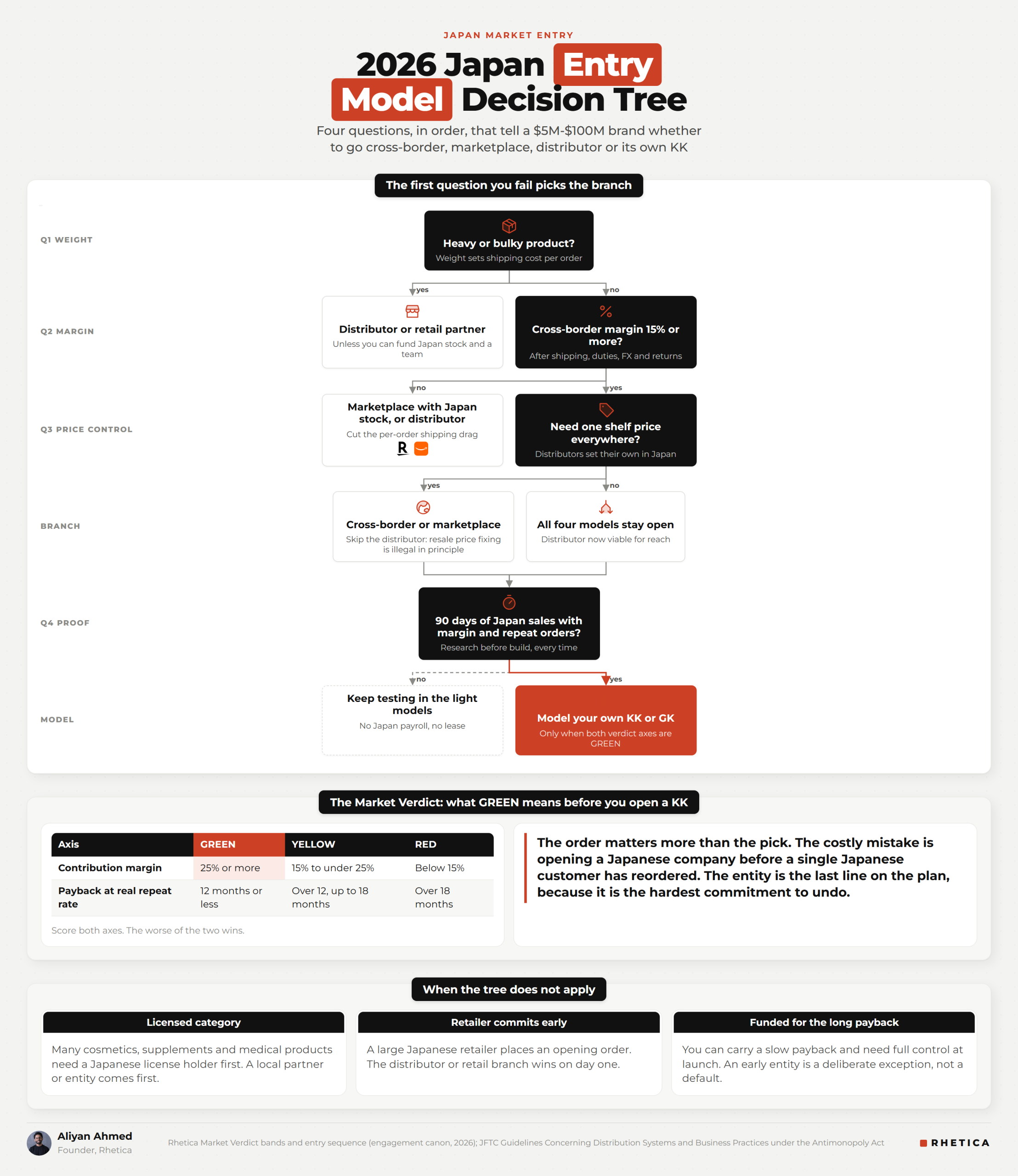
For most DTC brands, the best way to enter Japan is cross-border or marketplace selling first, because it tests demand without a fixed Japan cost base. A distributor suits heavy or retail-led products but takes control of price and brand. Set up a Japanese company last, once a 90-day test proves margin and repeat rate.
The order matters more than the pick. The costly mistake is starting with the biggest commitment, a local company, before a single Japanese customer has reordered. Rhetica is a B2B international-expansion and DTC growth consultancy that builds and operates new-market revenue. This guide gives you a decision tree for the four models and the numbers that move you from one to the next.
Get a Green, Yellow, or Red verdict on your next market in 5 minutes. Free, online, no call required.
Run the Margin DiagnosticWhat are the 4 ways to enter Japan?
The four Japan market entry strategies are cross-border selling, marketplace selling, a distributor, and your own Japanese company. They differ in how much fixed cost you carry in Japan and how much control you keep over price and brand.
Cross-border means you sell from your own store, in Japanese, and ship from your home warehouse or a third-party hub. You own the customer and the price. You carry no Japan payroll or lease. You pay for that freedom in delivery time and in shipping cost on every order.
Marketplace means you list on a Japanese platform such as Rakuten or Amazon.co.jp. The platform brings traffic and trust. You keep price control on your own listings, but you rent the customer, and platform fees come out of every sale. If you plan to stop there, read why an Amazon-only pilot is the wrong way to test a market before you commit.
A distributor buys your stock, imports it and sells it into Japanese stores and online. You get reach and local operations without hiring anyone. You give up most control over the final shelf price, and Japanese competition rules limit how much of it you can take back.
Your own company, a KK or a GK, means you hire, hold stock and run the market yourself. You get full control and no middleman in the margin. You also take on the highest fixed cost and the slowest exit.
| Model | Fixed cost in Japan | Price control | Who runs sales | Best for |
|---|---|---|---|---|
| Cross-border | None | Full | You, from home | Light products, first test |
| Marketplace | Low | Full on your listings | You, plus the platform | Products buyers search for by name |
| Distributor | Low for you | Limited by law | The distributor | Heavy or retail-led products |
| Own KK or GK | High | Full | Your Japan team | Proven demand with healthy margin |
Each model sits inside a wider plan for costs, channels and rules, which theguide to selling in Japan as a DTC brand lays out end to end.
How do you pick the right entry model for your product?
Pick the model by answering four questions in order: product weight, margin, need for price control, and proof of demand. The first question you fail usually decides the branch.
Weight comes first because it sets your shipping cost per order. A serum in a padded mailer crosses the Pacific cheaply. A mattress or a pizza oven does not. Heavy goods push you toward a partner who holds stock in Japan, or toward your own warehouse if you can fund one. Theways bulky DTC brands get into Japan show both paths in detail.
Margin comes second. Cross-border adds shipping, duties, payment fees and FX to each order. If your contribution margin falls below 15% after those lines, cross-border fails the margin test before ads even start.
Price control comes third. If your brand depends on one shelf price everywhere, a distributor is a weak fit in Japan, for legal reasons covered in the next section.
Proof of demand comes last, and it gates the most expensive move. Research-Before-Build is Rhetica’s rule that every market commitment, from a site to a warehouse to an entity, waits for a structured evidence pass on demand, unit economics and competitors. Build follows the verdict, never the reverse.
Here is the tree in plain steps.
- Is the product heavy or bulky? If yes, start with a distributor or retail partner, unless you can fund local stock and a team from day one. If no, go to step 2.
- Does cross-border margin stay at 15% or more after shipping, duties, FX and returns? If no, use a marketplace with local stock or a distributor. If yes, go to step 3.
- Do you need to control the shelf price? If yes, skip the distributor and stay cross-border or on a marketplace. If no, all branches stay open.
- Do you have 90 days of Japanese sales showing margin and repeat orders? If no, keep testing in the light models. If yes, model your own company.
Who controls the price with a Japan distributor vs your own company?
With your own company, you set the price. With a distributor, you can suggest a price but you cannot enforce it, because Japan treats resale price fixing as illegal in principle.
The rule comes from the Japan Fair Trade Commission’s distribution guidelines under the Antimonopoly Act. A supplier that restricts a distributor’s resale price is, in principle, engaging in an unfair trade practice (JFTC Guidelines Concerning Distribution Systems and Business Practices). The exception for a “justifiable reason” is narrow. It applies only when the restriction creates pro-competitive effects that no less restrictive method could achieve (JFTC guidelines, Japanese original).
You can share a suggested retail price, as long as it is only a reference. Making distributors stick to it is illegal, and the JFTC says non-binding wording is the better practice (JFTC guidelines).
There is one carve-out. If the partner sells on consignment and bears no risk of unsold goods, the brand setting the price is normally not illegal (JFTC guidelines). The catch is that you now carry the inventory risk, which is the cost you hired a distributor to avoid.
Real brands use both partner shapes. Ooni, the UK pizza oven brand, sells in Japan through Strix Design, a Tokyo company that runs Ooni Japan as its exclusive Japanese distributor (Ooni Japan company page). Hem, a Swedish furniture brand, launched through the Japanese interior retailer ACTUS, selling in its online shop and some of its own stores (madameFIGARO.jp). ACTUS still lists Hem as a brand on its site (ACTUS).
So choose a distributor for reach, and accept that the shelf price is theirs. Protect the brand with what you do control, such as product range, launch timing and the creative you supply. Have Japanese counsel review any clause that touches resale price or sales channels. Thequestions to ask a Japan market entry partner help you test a distributor before you sign.
When should you set up your own company in Japan?
Set up a KK or GK after a 90-day test proves contribution margin and payback inside your bands, not before. The entity comes last because it is the hardest commitment to undo.
The test you run is the Market Verdict. The Market Verdict is Rhetica’s two-axis test for whether to scale, fix, milk or exit a market. You score contribution margin and payback months, and the worse of the two wins.
The bands are fixed before you spend. Margin is GREEN at 25% or more, YELLOW from 15% to under 25%, and RED below 15%. Payback is GREEN at 12 months or less at the customer’s purchase frequency, YELLOW above 12 and up to 18 months, and RED beyond 18. Only GREEN on both axes earns a local company. The scale, fix, milk or exit verdict applied to a live market shows the full method.
Some brands do start with their own entity, and they have the money to match. Koala’s Japan company was established in October 2017 and now runs as Koala JP (Koala JP on PR TIMES). Its launch had a local country manager and next-day delivery across Japan, funded by a $10M investment from Partners for Growth (Inside Retail). Emma Sleep entered Japan in 2020 (Mynavi News) and operates through its own GK, Emma Sleep Japan (PR TIMES). Copy their structure only if you can copy their funding.
When we model a Japan entry, the entity is the last line on the plan, not the first. In my work with 30+ DTC brands personally launched into new markets, the plan that holds up is one beachhead, proven, then built out. Brands that open three markets at once still see revenue concentrate in one or two of them, with far more operational mess along the way (how to choose a beachhead market).
Once the verdict is green, the next choice is the legal form. The trade-offs between a KK and a GK, and whether you need either, are covered indo you need a Japanese company to sell in Japan.
For a B2B SaaS reader, the same order holds. Sell from home through direct contracts or a reseller first, and form a GK only when deal volume or a buyer’s procurement rules require a local counterparty.
What does the entry decision look like with real numbers?
Run the Market Verdict on your test data. If either axis lands YELLOW, fix the leak inside the current model, and only add an entity when both axes turn GREEN.
Take a brand doing $18M a year that tests Japan cross-border with a $90 skincare set. After 90 days, its True CAC in Japan is $60, fully loaded with media, creative, influencer costs and launch discounts. Contribution margin is 18% after product cost (COGS), shipping, duties, payment fees, FX, returns and support. Customers reorder at 0.25 orders per month, about once every four months.
The formula is payback months = True CAC / (AOV x contribution margin x monthly purchase rate).
| Input or result | Cross-border test | Band |
|---|---|---|
| True CAC | $60 | |
| Contribution margin | 18% | YELLOW |
| Purchase frequency | 0.25 orders per month per customer | |
| Orders to recover CAC | 3.7 | |
| Payback | 14.8 months | YELLOW |
Each order earns $16.20 in contribution ($90 x 18%), so the brand needs 3.7 orders to recover its CAC. At 0.25 orders per month per customer, that is 14.8 months of payback. Both axes are YELLOW, so the verdict is FIX with a 90-day cap. A KK does not belong on this plan yet.
Now say the brand moves stock into a Japan warehouse through a marketplace or 3PL, and contribution margin, still net of COGS and the same cost lines, rises to 26%. Each order now earns $23.40, so it takes 2.6 orders to recover CAC. At the same 0.25 orders per month repeat rate, payback drops to 10.3 months. Both axes are GREEN.
Only now does the entity question start. It becomes a narrower test of whether the margin gain covers the fixed cost of a Japanese company. If Japan is one of several markets on your list, settle the order first with sequencing international markets.
When this does not apply
If your category needs a Japanese license holder before you can sell at scale, as many cosmetics, supplement and medical products do, a local partner or entity comes first. If a large Japanese retailer commits to an opening order, the distributor or retail branch wins on day one. And if you are funded to carry a long payback period at your customers’ repeat rate and need full control from launch, an early entity can make sense as a deliberate exception to the bands.
Next:KK vs GK and whether you need a Japanese company, because once your test turns green, the legal form decides your cost, timeline and how easily you can exit.
If Japan is already on your list, apply for an Expansion Review.
Frequently asked questions
What is the best way for a foreign brand to enter Japan?
For most DTC brands, the best first move is cross-border or marketplace selling, because it tests Japanese demand without a fixed local cost base. A distributor suits heavy or retail-led products but takes control of the shelf price. A Japanese company should come last, once a 90-day test shows contribution margin and repeat rate strong enough to justify the fixed cost.
Can you sell in Japan without a Japanese company?
Yes. A foreign brand can sell to Japanese customers cross-border from its own store, list on a Japanese marketplace, or appoint a distributor, all without forming a KK or GK. Many brands test this way first. A local company makes sense once sales prove margin and payback, or when a license, a retailer or a procurement rule requires a Japanese counterparty.
Can a brand set the retail price a Japanese distributor charges?
In general, no. Japan’s Fair Trade Commission treats a supplier restricting a distributor’s resale price as illegal in principle under the Antimonopoly Act. A brand can share a non-binding suggested retail price as a reference. The main exception is true consignment, where the brand keeps the risk of unsold stock and can then normally set the price.
When does a DTC brand need a KK or GK in Japan?
A DTC brand should form a KK or GK after a Japanese sales test shows contribution margin of 25% or more and payback of 12 months or less at the customer’s purchase frequency. Before that, cross-border or marketplace selling tests demand at lower cost. Brands with heavy funding and a need for full control from launch sometimes form an entity earlier.
Should a heavy or bulky product use a distributor to enter Japan?
Often, yes. Heavy and bulky goods carry high shipping cost per order, which makes cross-border selling expensive. A distributor or retail partner holds stock locally and runs sales. Ooni entered Japan through an exclusive distributor and Hem through the retailer ACTUS. Brands with enough funding, such as Koala, instead built their own Japanese company with local delivery.
Get a Green, Yellow, or Red verdict on your next market in 5 minutes. Free, online, no call required.
Run the Margin Diagnostic