A cross-border Japan test costs far less than a local launch. The big fixed lines, a legal entity, local stock and a Japanese support team, can wait. Every order still pays commission, card fees, duty and import tax. The real cost is time, so plan for payback of well over a year unless buyers already know your brand.
In my work with 30+ DTC brands personally launched into new markets, the setup invoice is rarely what sinks a Japan plan. Rhetica is a B2B international-expansion and DTC growth consultancy that builds and operates new-market revenue. This page prices the cost side of ourguide to selling in Japan as a DTC brand. Every figure is in USD at the Federal Reserve rate for October 2, 2026.
Get a Green, Yellow, or Red verdict on your next market in 5 minutes. Free, online, no call required.
Run the Margin DiagnosticHow much does it cost to expand to Japan?
A two-marketplace test carries about $4,450 of fixed cost in year one, before stock and ads. Platform fees are public and small. The expensive lines arrive only when you build a local company.
The table shows what each channel charges before you sell a single unit. Amazon figures come from Amazon’s seller pricing page. Rakuten figures come from Rakuten’s plan page and a July 2026 fee guide.
| Line | Fixed fees | Year-one fixed cost | Source |
|---|---|---|---|
| Amazon.co.jp Professional plan | $31.05 a month | $372.60 | Amazon Seller Central Japan |
| Rakuten Ichiba, Ganbare plan | $380.20 to register, then $158.42 a month, billed yearly as $1,901.02 | $2,281.22 | Rakuten, STOCKCREW |
| Rakuten Ichiba, Standard plan | $380.20 to register, then $411.89 a month, billed every six months | $5,322.88 | STOCKCREW |
| Japanese listing translation | One-off budget for both stores | $1,800.00 | example input |
| Test total: Amazon Professional, Ganbare and translation | Amazon Professional + Ganbare + translation (excludes Standard) | $4,453.82 | example total |
Amazon also has an Individual plan that charges $0.63 per item sold instead of a monthly fee. (Source: Amazon Seller Central Japan) It suits a handful of test orders. Once you sell about 50 items a month, the Professional plan costs less.
Older guides still show lower Rakuten plan fees. Those pages are out of date, so check the date on any fee table you budget from.
The bigger fixed lines sit outside this table on purpose. A Japanese entity, stock in a Japanese warehouse and a Japanese support team turn a test into a launch. Pay for them only after the test proves demand at a payback you can fund.
Which store you open first changes your per-order take far more than your fixed cost. So compareRakuten vs Amazon Japan vs your own site on fees per order, not on plan price.
What does Japan take from every order?
On Rakuten, platform fees take about 8% to 15% of each sale before duty, shipping and returns. (Source: STOCKCREW 2026 Rakuten fee guide) That per-order stack, not the setup bill, decides your margin.
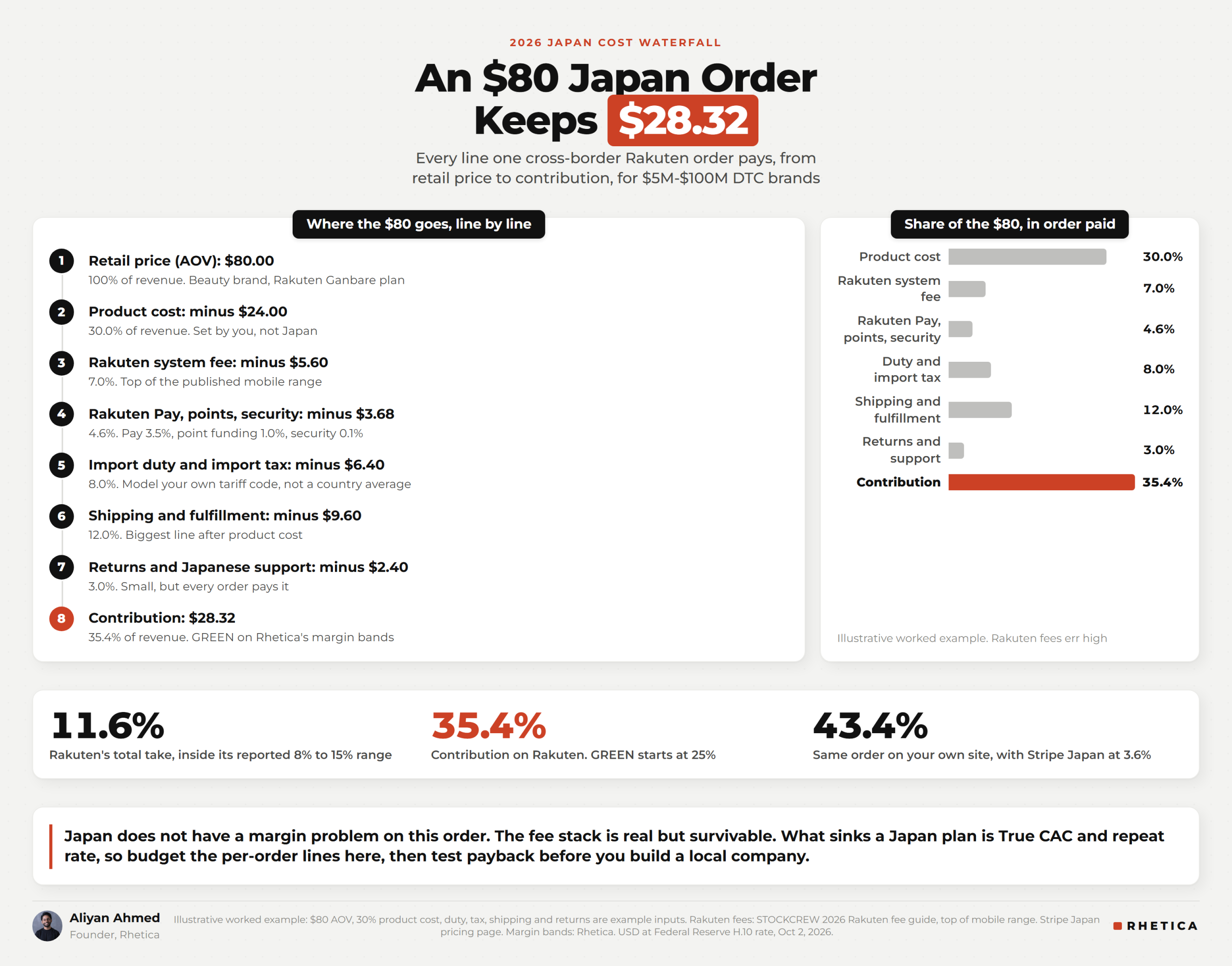
Take a beauty brand selling an $80 order on Rakuten’s Ganbare plan, with product cost at 30% of price. Each Rakuten fee uses the top of its published mobile range, so the example errs high.
| Line, per $80 order | USD | Share of revenue | Source |
|---|---|---|---|
| Revenue (AOV) | $80.00 | 100.0% | example input |
| Product cost (COGS) | $24.00 | 30.0% | example input |
| Rakuten system fee, top of mobile range | $5.60 | 7.0% | STOCKCREW |
| Rakuten Pay 3.5%, point funding 1.0%, security fee 0.1% | $3.68 | 4.6% | STOCKCREW |
| Import duty and import tax | $6.40 | 8.0% | example input |
| Shipping and fulfillment | $9.60 | 12.0% | example input |
| Returns and Japanese support | $2.40 | 3.0% | example input |
| Contribution margin | $28.32 | 35.4% | example result |
Rakuten’s lines total 11.6% here, inside the 8% to 15% range the guide reports. Contribution lands at 35.4%. Rhetica’s bands put 25% and above in GREEN, 15% to under 25% in YELLOW and under 15% in RED. So Japan does not have a margin problem on this order.
The channel moves this table most. Amazon.co.jp charges beauty sellers a referral fee of 5% to 10.4% of the sale price, with a $0.19 minimum per item. (Source: Amazon Seller Central Japan) Most other categories run 5% to 15.4%. On your own site, Stripe Japan takes 3.6% per card sale, plus 2% if it converts currency. (Source: Stripe Japan pricing)
Swap Rakuten’s 11.6% for Stripe’s 3.6% and contribution rises to 43.4%. Your own site brings no shoppers, though. The saving counts only once you can buy traffic at a CAC that pays back.
Duty depends on your product’s tariff code, so model your own code, not a country average. Tax is changing too. Under Japan’s FY2026 tax reform, the consumption-tax exemption for imports worth $63.37 or less is set to end on April 1, 2028. (Source: VATCalc) After that, the seller, or in some cases the platform, owes the tax. Cheap cross-border orders lose their tax edge, and the full rules are inJapan import duty and consumption tax for ecommerce.
What does it cost to win a Japanese customer?
Plan for a year-one Japan True CAC 60% to 120% above your home ad-spend-only CAC, then replace that assumption with your own test data. Cheaper ads do not close the gap, because a new brand converts worse.
True CAC is Rhetica’s fully loaded cost to win one customer. It adds paid media, agency fees, creative, influencer payouts and acquisition discounts, then divides by net new customers. In a new market it also picks up creative localization, payment drop-off at checkout, local returns and cross-border fraud, the lines that true CAC in international markets breaks down.
Japanese ad space does look cheap. One vendor’s 2026 projection puts Meta CPM at $11.50 in Japan against $23.00 in the US. (Source: AdAmigo) Meta publishes no country CPMs, and other 2026 benchmarks put Japan lower still. Treat it as a rough range. Half-price impressions still lose money if a brand nobody knows converts at half the rate.
Back to the beauty brand. Say its home ad-spend-only CAC is $40. The assumed band puts year-one True CAC at $64 to $88, and the example uses the low end, $64. At $28.32 of contribution per order, that takes 2.3 orders to recover.
Then check the Margin Ceiling. The Margin Ceiling is the most CAC your unit economics can pay, equal to lifetime contribution per customer divided by your target LTV:CAC ratio. Work it from expected orders per customer, since LTV needs a repeat input. If your best channel’s True CAC sits above the ceiling, no new creative fixes it. Lift AOV with bundles or cut variable cost first, using the AOV-to-CAC math for international markets.
How long until a Japanese customer pays you back?
In this example, payback takes 22.6 months in year one and 9.4 months once buyers know the brand, assuming True CAC falls from $64 to $40 and repeat rises from 0.10 to 0.15 orders per month per customer. Brand awareness, not the fee schedule, makes the difference.
Payback in months is True CAC divided by AOV times contribution margin times orders per month per customer. Without a purchase-frequency input, you can only state orders to recover.
- Year one at 0.10 orders per month gives $64 / ($80 x 35.4% x 0.10) = 22.6 months.
- Once the brand is known, assume fully loaded True CAC falls to $40 and repeat rises to 0.15 orders per month. That gives $40 / ($80 x 35.4% x 0.15) = 9.4 months.
Rhetica’s bands put payback of 12 months or less at the customer’s purchase frequency in GREEN, over 12 and up to 18 in YELLOW, and over 18 in RED. Margin and payback each get a band, and the worse band wins.
| Axis | Year one | Established brand |
|---|---|---|
| True CAC, fully loaded | $64 | $40 (assumed) |
| Repeat orders per month per customer | 0.10 | 0.15 |
| Contribution margin | 35.4%, GREEN | 35.4%, GREEN |
| Payback | 22.6 months, RED | 9.4 months, GREEN |
| Verdict | RED | GREEN |
Same product, same fees, same market. Year one runs 2.4x longer because the two inputs a known brand improves, True CAC and repeat, both start out worse. Teams that budget Japan CAC like home CAC get surprised in the second quarter, and theJapan payback period breakdown covers the inputs that move it.
Solve the formula backwards to set your gate. At 0.10 repeat orders per month, year-one True CAC must fall to about $51 to clear 18 months, and to about $34 to clear 12. At a $64 True CAC, repeat must rise to about 0.13 orders per month per customer to clear 18 months.
Three moves shorten it. Launch on a marketplace that lends you trust, lift AOV with bundles, or build repeat with refill offers and LINE follow-ups.
What should a 90-day Japan test cost?
On these inputs, a 90-day Rakuten test costs about $23,300 in cash and earns about $9,800 of contribution inside the window. The $13,500 gap is the price of being new, not proof the test failed.
The plan buys 300 new customers at a $64 True CAC. That is $4,000 a month in media plus a 60% load for agency, creative and localization. Repeat orders at 0.10 per month per customer add about 45 orders before day 90.
| Line | 90-day cost | Source |
|---|---|---|
| Rakuten registration | $380.20 | STOCKCREW |
| Ganbare plan, billed for the year | $1,901.02 | Rakuten |
| Listing translation | $1,800.00 | example input |
| Paid media, $4,000 a month | $12,000.00 | example input |
| Agency, creative and localization at 60% of media | $7,200.00 | example input |
| Total cash out | $23,281.22 | example total |
| Contribution, 345 orders at $28.32 | $9,770.40 | example result |
| Cash gap at day 90 | $13,510.82 | example result |
Read the table as a shape, not a price list. Swap in your AOV, margin and repeat rate and the shape holds. Fixed fees stay small, per-order fees stay real, and the cash gap depends on how fast Japanese buyers come back.
Set the stop rule before day one. If day-90 True CAC sits above $51 at 0.10 repeat orders per month, year-one payback cannot clear 18 months, so fix the offer or stop. The week-by-week plan is in the90-day Japan market test.
When this does not apply
These numbers assume a paid-led launch of a product people buy again. If your product sells once with no repeat, judge it on orders to recover and hold CAC under one order’s contribution. Cosmetics and supplements fall under Japan’s Pharmaceutical and Medical Device Act, so a licensed Japan-resident party has to be in place first, and that lead time sets your launch date. For a B2B SaaS seller, swap the per-order fees for local invoicing and bank-transfer billing, then run the same payback gate.
Put your own Japan AOV, fee stack and repeat rate in, and see which side of the 18-month line you land on.
Run the Rhetica Margin Diagnostic. It takes five minutes, pulls your CAC, payback and returns by market into one view, and flags which market fails the gate.
Frequently asked questions
How much does it cost to sell on Rakuten in Japan?
Rakuten Ichiba charges a one-time registration fee of about $380, and the Ganbare plan costs about $158 a month, billed yearly at about $1,901. Each sale then pays a system fee of 3.5% to 7.0%, Rakuten Pay at 2.5% to 3.5%, 1.0% point funding and a 0.1% security fee. A July 2026 fee guide puts the all-in variable cost at about 8% to 15% of sales.
What are Amazon Japan’s seller fees?
Amazon.co.jp’s Professional plan costs about $31.05 a month, plus a referral fee on each sale. Beauty items pay 5% to 10.4% of the sale price with a minimum of about $0.19, and most other categories pay 5% to 15.4%. The Individual plan charges about $0.63 per item sold instead, which suits only small test volumes. Dollar figures use the Federal Reserve rate of October 2, 2026.
Is it cheaper to advertise in Japan than in the US?
Impressions often cost less. One vendor’s 2026 projection puts Meta CPM at $11.50 in Japan against $23.00 in the US, though Meta publishes no country data. Customers do not cost less in year one, because a new brand converts worse. A workable planning assumption, not a measured benchmark, is a year-one Japan True CAC 60% to 120% above your home ad-spend-only CAC, replaced by test data once you have it.
How long does it take a DTC brand to break even in Japan?
It depends on how often customers reorder. In a worked example with an $80 order, 35.4% contribution and a $64 True CAC, payback takes 22.6 months at 0.10 orders per month per customer. If fully loaded True CAC falls to an assumed $40 once Japanese buyers know the brand, and repeat rises to 0.15 orders per month, payback drops to 9.4 months.
What changes for Japan import tax on ecommerce in 2028?
Under Japan’s FY2026 tax reform, the consumption-tax exemption for imported consignments worth about $63 or less is scheduled to end on April 1, 2028. After that, the seller, or in some cases the platform, becomes liable for Japanese consumption tax. Low-price cross-border orders lose their tax advantage, so price your 2028 margin with the tax included.