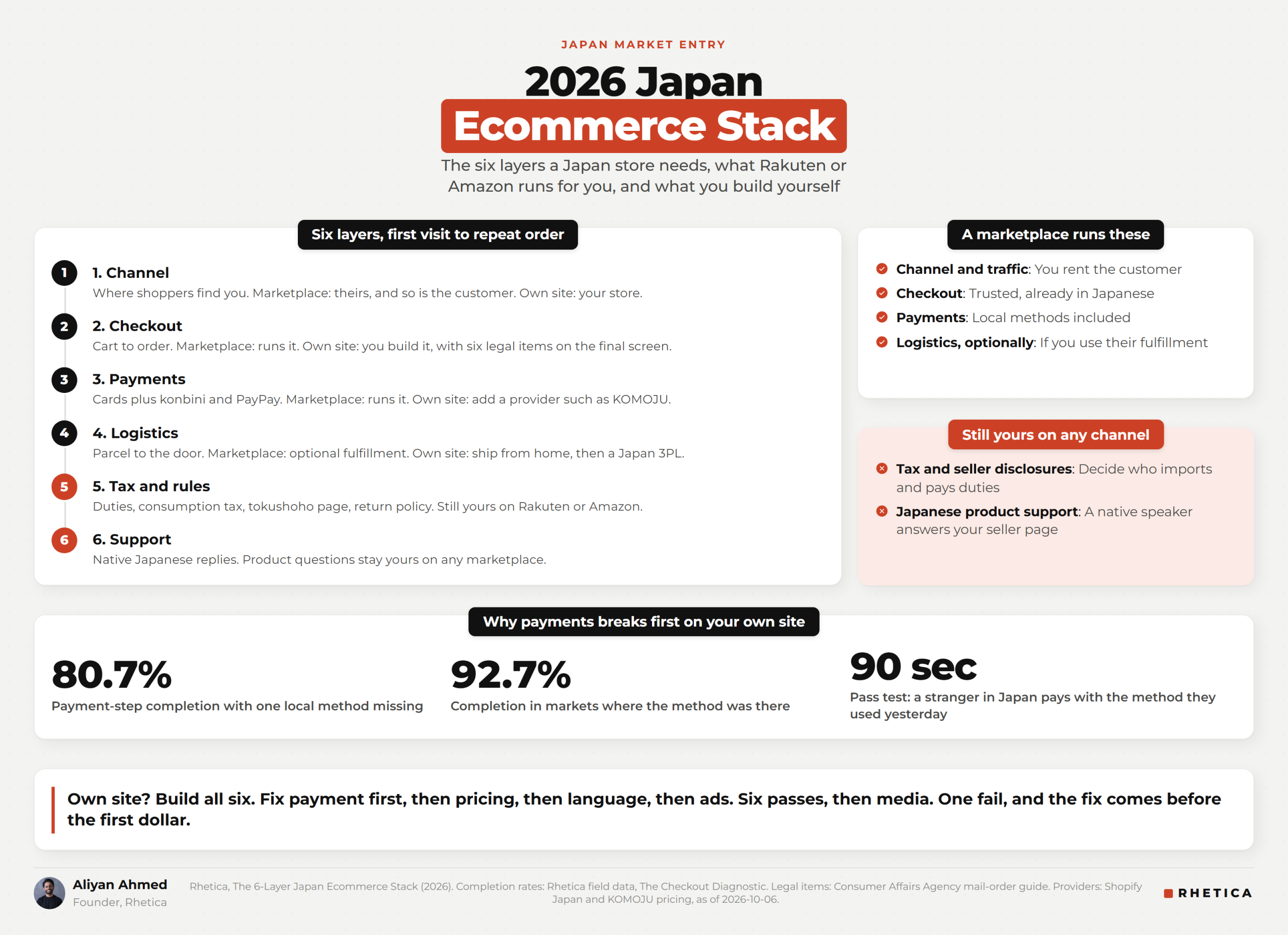
To sell online in Japan, you need six layers working together. They are a sales channel, a Japanese checkout, local payment methods, a delivery path, a tax and legal position, and Japanese-language support. Most foreign brands get the store right but break on payments or support. Fix checkout before buying ads, unless you only sell on a marketplace.
A weak layer is expensive. In my work with 30+ DTC brands personally launched into new markets, an unlocalized checkout leaves roughly 40% of revenue on the table. Rhetica is a B2B international-expansion and DTC growth consultancy that builds and operates new-market revenue. This stack is the build step ofselling in Japan as a DTC brand, and it comes after you decide Japan is worth a test.
Get a Green, Yellow, or Red verdict on your next market in 5 minutes. Free, online, no call required.
Run the Margin DiagnosticHow do you set up ecommerce in Japan?
You set up ecommerce in Japan by building six layers and testing each one before you buy traffic. A marketplace runs some layers for you, while your own site makes you build all six.
The 6-Layer Japan Ecommerce Stack is the set of six layers a store needs to take, ship and keep a Japanese order. Each layer can fail on its own. When one fails, the sale is lost, however good the other five are.
Think of the layers as a chain from first visit to repeat order. Channel and checkout win the first order. Payments, logistics and support decide whether it arrives and whether the shopper buys again. Tax and rules sit under all of them, because a missing disclosure can stop the store.
The table shows who builds each layer on a marketplace and on your own site.
| Layer | What it does | On Rakuten or Amazon Japan | On your own site |
|---|---|---|---|
| Channel | Where the shopper finds you and buys | The marketplace | Your store |
| Checkout | The steps from cart to order | Run by the marketplace | You build it |
| Payments | The ways a shopper can pay | Run by the marketplace | You add providers |
| Logistics | How the parcel reaches the door | Optional marketplace fulfillment | You choose a path |
| Tax and rules | Duties, consumption tax and seller disclosures | Still yours | Yours |
| Support | Japanese answers before and after the sale | Product questions stay yours | Yours |
Most international strategies are domestic strategies with a shipping plugin. The stack fixes that, because it forces a decision on every layer before launch.
Build order matters too. Fix payment first, then pricing, then language, and only then spend on ads. A store with great copy and the wrong payment methods still loses the order at the last step.
Which sales channel should you launch on first?
Launch first on the channel whose missing layers you can afford to build. A marketplace brings traffic and a trusted checkout but keeps the customer. Your own site keeps the customer but hands you every other layer.
If you want traffic before brand, compareRakuten, Amazon Japan and your own site on fees and customer ownership before you build anything.
Shopify is the common own-site choice. Its Japan plans cost about $23, $64 and $279 a month on annual billing (Source: Shopify Japan pricing).
The real hurdle sits one layer down. Shopify Payments Japan requires a Japanese home or business address. It also needs a local-currency savings account, called a futsu account, at a bank in Japan (Source: Shopify Payments Japan requirements).
A brand with no Japanese entity has a second route. It keeps its home Shopify store and adds a Japanese payment provider on top. Before you plan around that, confirm the provider will onboard a merchant with no entity in Japan.
Which payment methods does a Japan store need?
A Japan store needs cards plus the local methods shoppers used yesterday, such as konbini and PayPay. Shopify Payments Japan covers cards and wallets only, so the local methods come from a third-party provider.
Konbini payment lets a shopper order online, then pay in cash at a convenience store. PayPay is a phone wallet. Both matter because the habit decides the checkout, and in Japan the habit is not always a card.
Shopify Payments Japan accepts American Express, JCB, Mastercard and Visa, plus Apple Pay, Google Pay and Shop Pay. Its official page lists no konbini, PayPay, Pay-easy or bank transfer (Source: Shopify Help Center, Japan payment methods). JCB, Japan’s home card brand, works there only when you charge in Japanese currency.
Providers fill the gap. In 2020, Shopify announced that SB Payment Service added PayPay, konbini payment at five store chains and Pay-easy (Source: Shopify Japan blog). KOMOJU is another provider, with no setup or monthly fee. Fees as of 2026-10-06 come from Shopify Japan pricing and KOMOJU pricing.
| Provider and method | Fee per payment |
|---|---|
| Shopify Payments Japan, domestic cards, Basic plan | 3.55% |
| Shopify Payments Japan, domestic cards, Advanced plan | 3.25% |
| Shopify Payments Japan, international cards | 3.9% |
| KOMOJU, cards | 3.25% |
| KOMOJU, konbini | 2.75% |
| KOMOJU, Pay-easy | 2.75% |
| KOMOJU, PayPay | from 3.5% |
The fee gap between methods is small. The gap in completed orders is not. Pick methods by what your buyer already uses, and add them in the order set out inJapan payment methods for ecommerce.
How do you know your checkout is ready for Japan?
Your checkout is ready when a stranger in Japan can pay you in under 90 seconds with the method they used yesterday. If they cannot, fix payment before you touch ad spend.
That test is the Checkout Diagnostic. The Checkout Diagnostic is Rhetica’s field-tested check of whether a local stranger can finish paying fast with a familiar method. It is why checkout kills more international revenue than weak demand for most $5M to $100M brands.
Here is what one missing method costs. We have traced payment-step completion of 80.7% in one market against 92.7% in others, and the gap came from a missing local method.
Now take a store where 1,000 Japanese shoppers reach the payment step each month, with a $90 average order. At 80.7% completion, it books 807 orders, or $72,630. At 92.7%, it books 927 orders, or $83,430. The fix is worth $10,800 a month, close to 15% more revenue, before a single new ad dollar.
The law also shapes the last screen. Under the Specified Commercial Transactions Act, the final confirmation screen must show quantity, price with shipping, payment timing and method, delivery timing, any application period, and cancel and return terms (Source: Consumer Affairs Agency, mail-order guide). Run the diagnostic on that real screen, not on a demo.
What does Japanese law require from an online seller?
Japanese law requires a seller-disclosure page, a stated return policy and a clear tax position. The page comes from the Specified Commercial Transactions Act, and foreign sellers must also show an office location in Japan.
The page is known as the tokushoho page. It must show price including shipping, how and when payment happens, and when goods ship. It must also show cancel and return terms, your business name, address and phone, a responsible person, any extra costs and subscription renewal terms (Source: Consumer Affairs Agency, mail-order guide).
Returns need a written rule. Mail order in Japan has no cooling-off period. But if your store shows no return policy, a shopper can cancel within 8 days of receiving the goods and send them back at their own cost (Source: Consumer Affairs Agency). Write the policy you want before launch, or the default writes it for you.
The stakes are real. Breaches can lead to orders to improve, business suspension, bans on officers and, for some breaches, criminal penalties.
The tax half of this layer is a decision, not a page. Decide who imports the goods and who pays duties and consumption tax, because that sets your landed price and what the shopper pays at the door. The line items sit in what it costs a US DTC brand to enter Japan.
How should you handle delivery and Japanese support?
Ship from home while you test demand, then move stock to a Japan 3PL once order volume pays for it. Staff support with a native Japanese speaker from day one, because your seller page lists a phone number someone must answer.
Cross-border shipping keeps cash out of stock. The shopper waits longer, and unless you prepay duties, the bill lands at the door. A Japan 3PL gives fast local delivery and a local return address, but you fund stock in the market.
The switch point depends on monthly orders, parcel weight and return rate. Modelthe break-even between a Japan 3PL and cross-border shipping instead of guessing. Whatever path you pick, promise only the delivery window you can hit. The date on your seller page is a legal statement, not a hope.
Support covers four jobs. It answers product questions before the sale, confirms konbini payment status, handles delivery changes and runs returns. Keep replies in polite Japanese that matches your store copy.
Language comes last in the build order for store copy, not for support. A shopper with a stuck order needs an answer they can read, on the same day.
Before you spend on ads, score each layer pass or fail.
| Layer | Pass test |
|---|---|
| Channel | You know who owns the customer, and you chose that on purpose |
| Checkout | The final screen shows all six required items |
| Payments | A stranger in Japan pays in under 90 seconds with konbini, PayPay or a card |
| Logistics | The delivery window on your seller page matches what you ship |
| Tax and rules | Tokushoho page live, return policy written, duty owner decided |
| Support | A native speaker answers the phone and email on your seller page |
Six passes, then ads. One fail, and the fix comes before the first dollar of media.
When this does not apply
If you sell only on Rakuten or Amazon Japan, the marketplace runs checkout and payments, so the Checkout Diagnostic does not apply. Your work shrinks to channel, logistics, tax and product support. If your product is content, such as courses or apps, language is the product and comes before payment. For B2B SaaS on contracts, skip konbini and wallets and test whether a Japanese buyer can get a local invoice and pay by bank transfer.
Next:Japan payment methods for ecommerce in 2026, because payments is the layer that breaks first, and that post sets which methods to add and in what order.
If Japan is already on your list, apply for an Expansion Review.
Frequently asked questions
Can a foreign brand use Shopify Payments in Japan?
Only with a Japanese base. Shopify Payments Japan requires a Japanese home or business address and a local-currency futsu savings account at a bank in Japan. It accepts major cards plus Apple Pay, Google Pay and Shop Pay, but its official page lists no konbini or PayPay. A brand without a Japanese entity can keep its home Shopify store and add a Japanese payment provider, after confirming the provider will onboard it.
What is a tokushoho page?
A tokushoho page is the seller-disclosure page that Japan’s Specified Commercial Transactions Act requires from online sellers. It lists price including shipping, payment timing and method, delivery timing, cancel and return terms, business name, address, phone, a responsible person and any extra costs. Foreign businesses must also show an office location in Japan. Breaches can lead to orders to improve, business suspension or, in some cases, criminal penalties.
Do you need konbini payment to sell online in Japan?
If you run your own store for Japanese consumers, plan on offering it. Konbini payment lets a shopper order online and pay in cash at a convenience store. Shopify Payments Japan does not list it, so you add it through a provider such as SB Payment Service or KOMOJU, which charged 2.75% per konbini payment as of October 2026 with no setup or monthly fee.
What happens if a Japan online store has no return policy?
Mail order in Japan has no cooling-off period, but silence has a cost. If your store shows no return policy, a shopper can cancel within 8 days of receiving the goods and send them back at their own shipping cost. Write a clear return policy before launch and show it on your seller-disclosure page and on the final confirmation screen of your checkout.
Should a DTC brand sell on Amazon Japan or its own site first?
Choose by who should own the customer and which layers you can afford to build. A marketplace such as Amazon Japan or Rakuten runs checkout and payments and brings traffic, but keeps the customer relationship. Your own site keeps the customer and the data, but you must build all six layers yourself, including local payment methods, a seller-disclosure page and Japanese support.
Get a Green, Yellow, or Red verdict on your next market in 5 minutes. Free, online, no call required.
Run the Margin Diagnostic