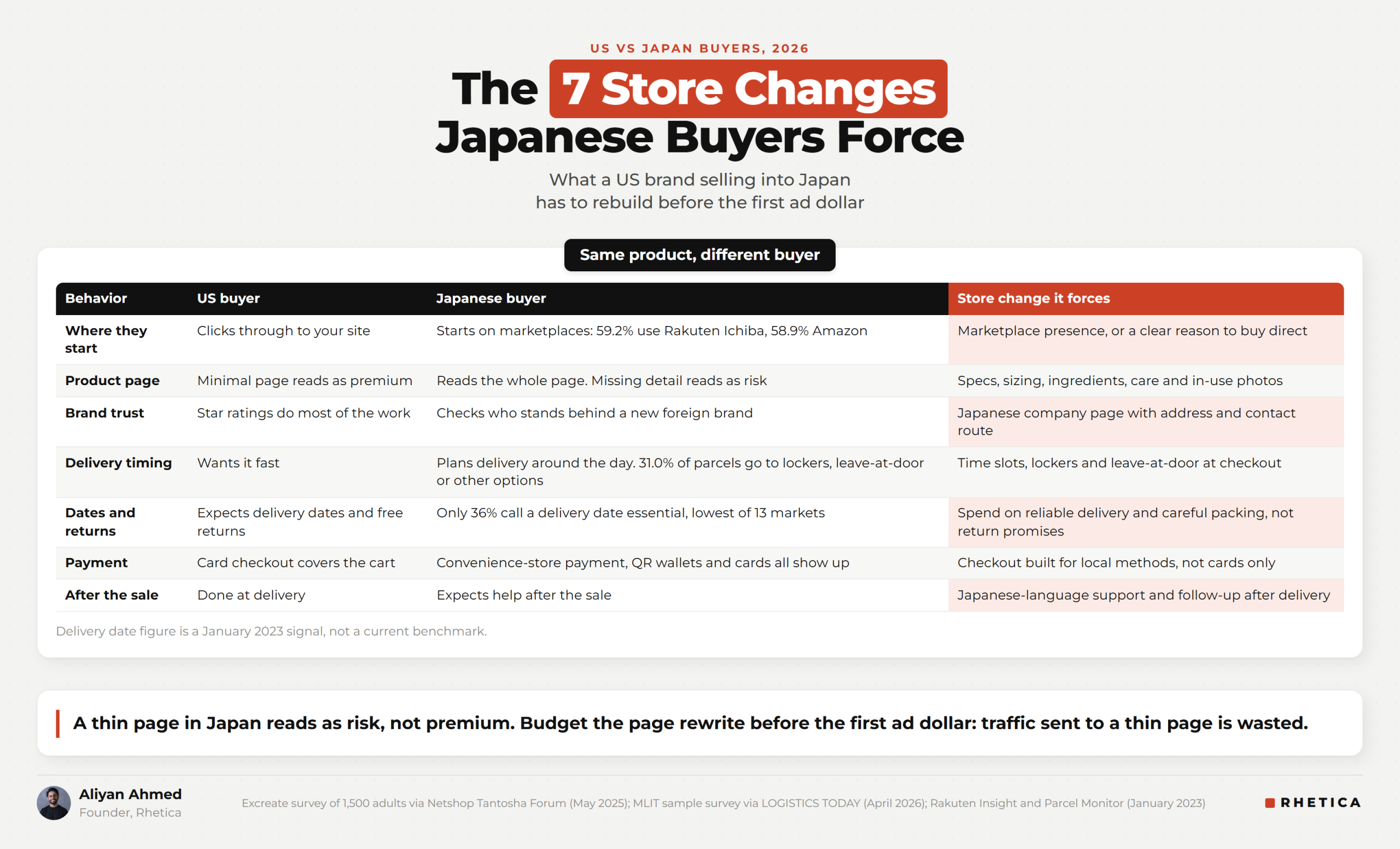
Japanese shoppers read more before they buy. They expect delivery on their schedule and want proof the brand will still be there after the sale. They pay with a wider mix of methods and start on domestic marketplaces. A minimal US product page often reads as thin, not premium, unless detail, reviews and local support back it.
The market is big enough to get right. Japan’s B2C e-commerce reached about $165.5B in 2024, according to METI’s 2024 e-commerce survey. Yet only 9.78% of physical-goods retail sold online that year (METI report). There is still room to grow.
The first-market mistakes checklist: the errors that sink a first international market, and how to spot them before you spend.
Get the checklistRhetica is a B2B international-expansion and DTC growth consultancy that builds and operates new-market revenue. Before you rebuild anything, test whether Japan is worth it for your DTC brand. The Japan Readiness Index is Rhetica’s scoring test for whether a DTC brand is ready to sell in Japan.
How is Japanese consumer behavior online different from US shoppers?
Japanese consumer behavior online differs from US habits in seven ways, and each forces a change to your store. The gap is about trust, timing and payment more than taste.
- They start on marketplaces. In a May 2025 survey of 1,500 adults, 59.2% named Rakuten Ichiba as a mall they use for everyday shopping. Amazon came in at 58.9% (Excreate survey via Netshop Tantosha Forum). Store change: plan a marketplace presence, or give a clear reason to buy direct.
- They read the whole page. Buyers look for size, ingredients, use and care before they decide. Store change: longer product pages with specs and photos of the product in use.
- They look for proof the brand will last. A new foreign brand has to show who stands behind it. Store change: a real company page in Japanese with an address and a contact route.
- They plan delivery around their day. Store change: time slots, lockers and leave-at-door options at checkout.
- They care less about fast dates and free returns. Store change: spend on reliable delivery and careful packing, not on return promises.
- They pay in more ways. Store change: a checkout built for local methods, not cards only.
- They expect help after the sale. Store change: Japanese-language support and follow-up after delivery.
Why does a minimal US product page read as thin in Japan?
A sparse page tells a Japanese buyer the brand has not done the work. Japanese website design favors dense, complete pages, because the page has to answer every question a store clerk would.
US brands often strip pages down to look premium. In Japan, missing detail reads as risk. Buyers want ingredient lists, sizing charts, dimensions, usage steps and reviews written in Japanese.
Trust signals in Japan ecommerce go beyond star ratings. Shoppers check for a company name, a physical address, a phone or chat route and a clear returns policy. Online sellers must also publish a seller disclosure page under the Specified Commercial Transactions Act.
Language is a trust signal too. A page that reads like a machine translation tells the buyer nobody local is behind it. How far you go withlocalizing your store for Japan decides how much of that gap you close.
When we model a Japan launch, we budget for the page rewrite before the first ad dollar. Traffic sent to a thin page is wasted. For SaaS readers, the same rule holds. Do not treat Japan as a copy-paste market just because the product is digital. In my view, that is the most expensive mistake in this corridor. Your pricing page and docs need the same depth.
What do Japanese shoppers expect from delivery and payment?
Japanese customer expectations center on delivery that fits their schedule and a checkout with the methods they already use. Precision and choice matter more than raw speed.
Missed deliveries are a national issue. In April 2026, 7.6% of parcels needed a second delivery attempt, and 31.0% were received through lockers, leave-at-door or other options (MLIT sample survey via LOGISTICS TODAY). The government targets about 50% for those options by FY2030 (MLIT).
Delivery dates and free returns move Japanese buyers less than US habits suggest. In a January 2023 Rakuten Insight and Parcel Monitor study, only 36% of Japanese respondents said an estimated delivery date was essential. That was the lowest of 13 markets. Another 36% were neutral on free returns, against a 15% average across markets (same study). Treat it as a dated signal, not a current benchmark.
Cash on delivery is smaller than many founders assume. Only 5% of Japanese online shoppers used it in a 2022 survey, versus 12% in the US (Rakuten Insight). The real issue is variety. Convenience-store payment, QR wallets and cards all show up, and your mix ofJapan ecommerce payment methods decides how many carts you keep.
The job does not end at delivery. Customers abroad churn because they feel forgotten, not because the product is bad. A Japanese follow-up email and fast replies in Japanese keep them buying.
What does this mean for your store’s numbers?
Each difference shows up in your conversion rate, and conversion rate sets your True CAC. A store that ignores these habits pays more for every Japanese customer.
True CAC is fully loaded: paid media, agency fees, creative, influencer costs and acquisition discounts, divided by net new customers. Here is how to measure true CAC in a new market without the blended number hiding the cost.
Take a brand doing $18M that tests Japan with a $60 True CAC, a $50 average order and a 30% net contribution margin. Net contribution margin is revenue minus COGS, shipping and fulfillment, payment fees, returns and duties, before fixed costs. Use it, not gross margin, or you will understate the orders you need. Orders to recover CAC equal True CAC divided by average order times net contribution margin. Here that is $60 / ($50 x 30%), or 4 orders.
Now rebuild the product page and add local payment and delivery options. If conversion rises 30% on the same ad spend, True CAC falls to about $46. Orders to recover drop to about 3.1.
Whether that is enough depends on how often customers buy again. The AOV-to-CAC math for international markets shows how repeat purchase frequency turns orders into months.
When this does not apply
If you only sell through Rakuten or Amazon Japan, the marketplace sets most page, checkout and delivery rules. Your levers shrink to listings and reviews. If your buyers are English-speaking expats or cross-border fans of a US brand, US-style pages can work. If you cannot fund Japanese-language support, fix that first, because a better page only brings in customers you cannot serve.
Next:the category rules for selling cosmetics, supplements or food in Japan, because a store that converts still cannot ship a product that fails import checks.
If Japan is already on your list, apply for an Expansion Review.
Frequently asked questions
How do Japanese people shop online?
Most Japanese shoppers start on domestic marketplaces. In a May 2025 survey, 59.2% used Rakuten Ichiba and 58.9% used Amazon for everyday shopping. They read full product pages, check who stands behind the brand, choose delivery slots or lockers, and pay with cards, convenience-store payment or QR wallets. Brands selling direct need detailed Japanese pages and local support to compete.
What trust signals do Japanese ecommerce shoppers look for?
Japanese shoppers look for a company name, a physical address, a contact route, a clear returns policy and reviews written in natural Japanese. Online sellers in Japan must also publish a seller disclosure page under the Specified Commercial Transactions Act. A page that reads like machine translation signals that no local team stands behind the brand.
Do Japanese shoppers expect free returns and fast delivery?
Less than US shoppers do. In a January 2023 Rakuten Insight and Parcel Monitor study, only 36% of Japanese respondents called an estimated delivery date essential, the lowest of 13 markets, and another 36% were neutral on free returns. Japanese buyers value reliable delivery that fits their schedule, such as time slots and lockers, more than speed promises.
How is Japanese website design different from US ecommerce design?
Japanese ecommerce pages carry more detail than US pages. Buyers expect specs, sizing, ingredients, usage steps, company information and Japanese reviews on or near the product page. A sparse, image-led US layout that signals premium at home often reads as thin or risky in Japan, which lowers conversion and raises the cost of each new customer.
Is cash on delivery still common in Japan?
No. A 2022 Rakuten Insight survey found only 5% of Japanese online shoppers used cash on delivery, against 12% in the US. The bigger checkout issue is variety, because convenience-store payment, QR wallets and cards all matter. A cards-only checkout loses Japanese buyers who prefer local payment methods.
The first-market mistakes checklist: the errors that sink a first international market, and how to spot them before you spend.
Get the checklist