Japan is a good market for DTC brands with real repeat purchase, a premium price position and the patience for a slow first year. It is a poor first market if you need fast payback. Shoppers stay loyal once you win them, but being new in Japan costs more than most brands model.
Only 9.78% of goods spending in Japan happens online (Source: METI e-commerce survey, 2024 data). You are not fighting for space on a crowded online shelf. You are paying to be found at all. The wider lane sits in our guide toselling in Japan as a DTC brand.
The first-market mistakes checklist: the errors that sink a first international market, and how to spot them before you spend.
Get the checklistIs Japan a good market for ecommerce brands in 2026?
Yes, if you can wait for the money. Japan is one of the largest online goods markets in the world, and household adoption is still climbing.
Japanese shoppers bought about USD 96.8 billion of physical goods online in 2024. The total online market grew 5.1% that year (Source: METI).
| Demand signal | Latest figure | As of |
|---|---|---|
| Goods bought online in Japan | about USD 96.8 billion | 2024 |
| Share of goods spending bought online | 9.78% | 2024 |
| Households shopping online in a month | 56.9% | 2025 |
| Monthly spend per online-shopping household | about USD 301 | 2025 |
Household habit matters more than the headline total. In 2025, 56.9% of Japanese households bought something online in a given month (Source: Statistics Bureau household survey). Those that did spent about USD 301 that month. That is a routine, not a trial.
Growth is steady rather than explosive, and that is the point. A market growing 5.1% a year does not reward a land grab (Source: METI). It rewards a brand that compounds repeat orders.
Those four lines are the demand case, and the demand case is not the decision. Rhetica is a B2B international-expansion and DTC growth consultancy that builds and operates new-market revenue. In my work across 100+ international expansions across B2B, SaaS, trading and DTC, brands that stalled in Japan rarely stalled on demand. They ran out of time before the second order arrived. A couple of them closed Japan inside the first year with a working store and a rising repeat rate. The budget ended before the cohort did.
What is the 7-Signal Japan Readiness Index?
The 7-Signal Japan Readiness Index is Rhetica’s pass or fail test for whether a DTC brand is ready to enter Japan. You score seven signals before any money moves, and the count tells you to enter, stage the entry or wait.
- Repeat purchase. Pass if a fifth or more of your first-time buyers order again within 90 days at home. Score it on your own 90-day cohort, not a lifetime average. No credible Japan-specific DTC repeat-rate benchmark exists, so use your own data rather than a published figure.
- Price position. Pass if your Japan price holds after the 10.0% consumption tax on the sale and still leaves 25% contribution margin (Source: National Tax Agency). Discounting your way in breaks this signal first.
- Landed cost. Pass if the parcel still pays once duty applies. Customs value at or below about USD 64 is free of duty and import consumption tax, with category exclusions including knit apparel, footwear and leather bags (Source: Japan Customs). Most DTC baskets sit above that line, so model duty in from day one.
- Payback tolerance. Pass if you can fund recovery past 12 months at your customer’s purchase frequency. Write down the number your board will accept before you see the model, not after.
- Growth profile. Pass if you accept that you are Multinational, not Universal. The Four Global Growth Profiles sorts brands by whether the same buyer exists at scale in every market, and below roughly USD 100M in revenue you are almost certainly not Universal, as set out in the four global growth profiles.
- Category headroom. Pass if your category is still thin online in Japan. With 9.78% of goods spending online, your real rival is often a shelf in a store (Source: METI). A thin online share is an opening, not a warning.
- Aftercare. Pass if you can answer a question in Japanese inside one business day and take returns inside Japan. Buyers read the returns policy before the first order, not after it.
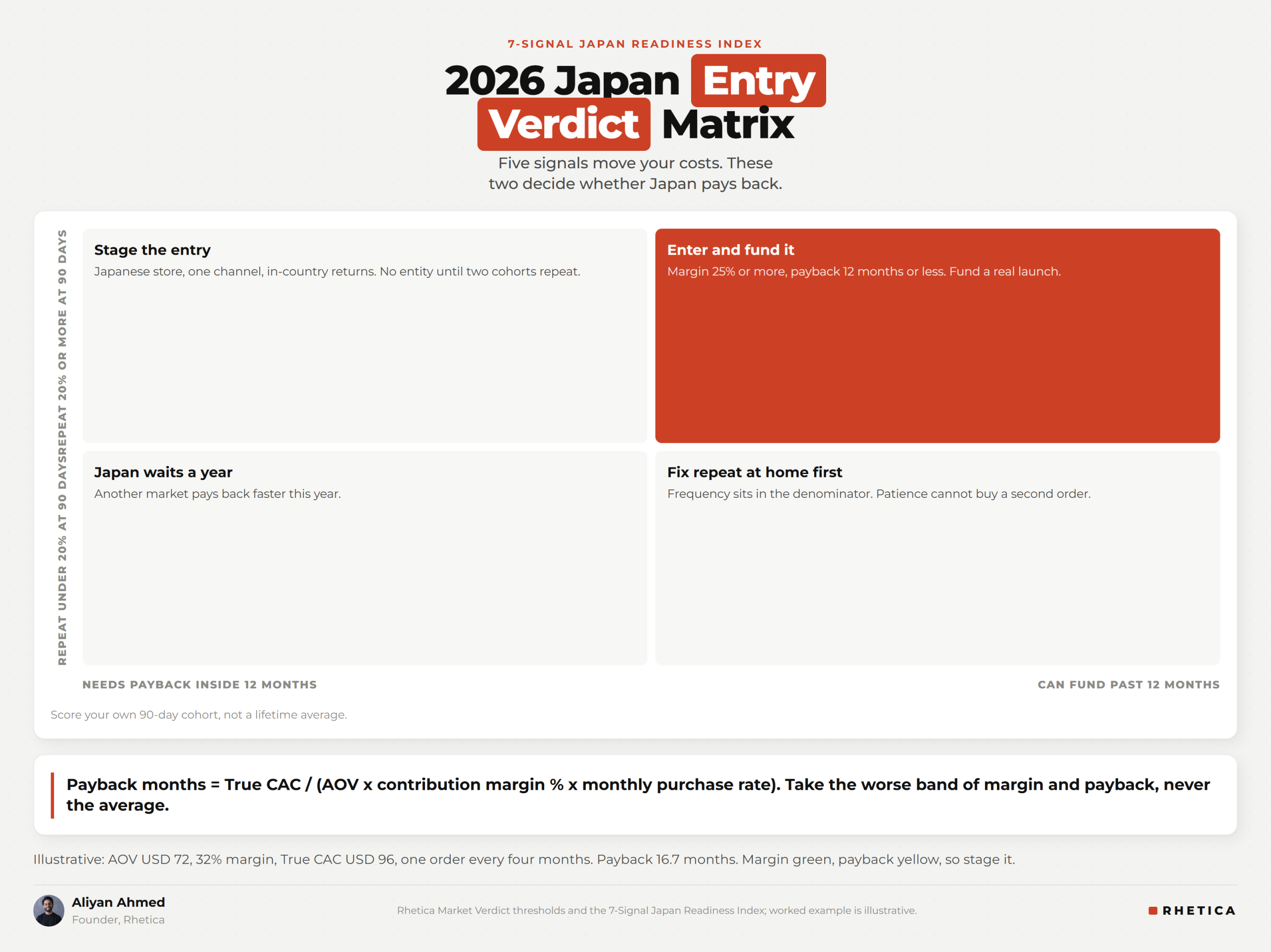
Score six or seven and you enter. Score four or five and you stage the entry. Score three or fewer and Japan waits a year. Signals one and four carry extra weight: fail either one and your ceiling is a staged entry, whatever the total says.
Which two signals decide the verdict?
Repeat purchase and payback tolerance decide it. The other five move your costs. These two decide whether Japan pays back at all.
The Market Verdict is Rhetica’s two-axis test for whether to scale, fix, milk or exit a market. It scores contribution margin and payback months, then takes the worse of the two. Margin is green at 25% or more, yellow from 15% to under 25%, and red below 15%. Payback is green at 12 months or less at the customer’s purchase frequency, yellow above 12 and up to 18 months, and red above 18.
Payback months = True CAC / (AOV x contribution margin % x monthly purchase rate). True CAC is the fully loaded cost to win one new customer in the market. It adds media, creative and agency fees, platform and tooling, and any promotional discount. Then it divides by new customers only, never blended across repeat orders. Name the frequency input every time. Without one, state orders to recover instead.
Take a brand doing USD 18M a year. In year one its Japan numbers read AOV USD 72, contribution margin 32% after duty, tax, shipping and returns, True CAC USD 96, and one order every four months. That is 0.25 orders per customer per month.
The 32% margin breaks down as shares of revenue, with revenue set at 100%.
| Line | Share of revenue |
|---|---|
| Revenue | 100% |
| COGS | 28% |
| Shipping and duty | 18% |
| Payment and FX | 5% |
| Returns and reverse logistics | 13% |
| Japanese-language support | 4% |
| Contribution margin | 32% |
Returns and in-country support are the two lines founders leave out of the model. Together they take 17 points of margin here, and both are the price of being trusted in Japan.
Payback lands at 16.7 months at that purchase frequency. Margin is green and payback is yellow, so the worse band wins. The verdict is yellow, which means stage the entry rather than fund a full launch.
With no frequency input, the honest number is orders to recover. USD 96 divided by USD 72 x 32% is 4.2 orders per customer. A brand whose buyers order twice a year waits years for that. Our note onwhy Japan payback runs longer in year one walks the three inputs that flip it, and how to calculate true CAC in a new market shows why a blended number hides the gap.
What makes being new in Japan expensive?
Time and trust, not media rates. A Japanese buyer wants proof before a first order, and proof takes months to build.
Four lines usually move the first-year P&L. A Japanese-language store and support team. Duty and the 10.0% consumption tax once a parcel passes the de minimis line (Source: National Tax Agency). Returns handled inside Japan. And a slow first year of conversion, because nobody knows you yet.
Plan on roughly two quarters before paid traffic converts at your home-market rate. Treat that as a planning assumption, not an observed rate. That lag, not the media price, is what stretches recovery at your customer’s purchase frequency.
Tax registration arrives sooner than founders expect. The small-business exemption ends once taxable sales in the base period pass about USD 63,600 (Source: National Tax Agency). Budget for a tax agent in the plan, not as a surprise in month eight.
The Japan Inversion is Rhetica’s rule for this corridor. When contribution margin clears but payback breaches your cap, Japan is a sequencing problem, not a demand problem. The rule was built on B2B software cost lines, so a DTC brand swaps in parcels, duty and returns. The instruction is the same. Enter early, stage it, and defer fixed cost until repeat orders prove the aftercare holds.
Demand keeps confirming the pull. In one 11-day window, 45.0% of companies that named a target market named Japan, as reported in why 179 companies pointed at Japan. Read that as convergence, not a forecast.
The other half of the cost is habit. How people pay, read reviews and return goods in Japan changes your store design, which is the subject of how Japanese shoppers buy online. Expect to add local payment options, longer product pages and far more proof than your home store carries.
Should you enter, stage the entry, or skip Japan?
Count your passes, then follow the Market Verdict. The index tells you how hard Japan will be, and the verdict tells you whether to spend.
A six or seven score with a green verdict means enter and fund a real launch. A six or seven score with a yellow verdict means stage it. Start with a Japanese-language store, one channel and in-country returns, and hold off on an entity or local inventory until repeat orders show up. A red verdict on margin is not a sequencing problem, and no amount of patience fixes it.
Stage in that order for a reason. The store and in-country returns lift conversion, which pulls True CAC down. Local inventory and a legal entity add fixed cost before you know the cohort repeats. Hold both until a second-order rate holds steady across two cohorts in a row.
Four or five passes means you pick the one failing signal and fix it at home first. Repeat purchase is usually the cheapest to fix and the one that changes the math most, because frequency sits in the denominator. Three or fewer passes means a different market pays back faster this year.
Category is the last filter, and it is the one most brands skip. A 9.78% online share of goods spending is thin in some categories and already crowded in others (Source: METI), so checkwhere Japan’s ecommerce market still has room before you commit a budget.
When this does not apply
This index assumes a repeat-purchase consumer product sold direct. If you sell a one-time high-ticket item, repeat purchase cannot carry payback, and you need gross margin above 50% on the first order instead. If a Japanese distributor or retailer is already asking for your product, the economics change, because they carry the acquisition cost and you trade margin for speed. B2B SaaS readers should score signals four, five and seven only, and a brand whose home market still grows above 30% a year should fix the cheaper growth first.
Next:where Japan’s ecommerce market still has room for a foreign brand, because signal six turns on your category, not the market total.
If Japan is already on your list, apply for an Expansion Review.
Frequently asked questions
Is Japan a good market for ecommerce brands?
Japan is a good market for brands with repeat purchase, a premium price and the funding to wait past 12 months for payback. Shoppers bought about USD 96.8 billion of physical goods online in 2024, and 56.9% of households shopped online monthly in 2025. It is a poor first market when you need fast recovery of acquisition cost.
How long does it take to break even in Japan?
Payback months equal True CAC divided by AOV times contribution margin times monthly purchase rate, where True CAC is fully loaded acquisition cost divided by new customers only. A brand with USD 96 True CAC, USD 72 AOV, 32% margin and one order every four months recovers in about 16.7 months at that purchase frequency. That is the yellow band, so stage the entry.
Is Japan hard to enter for a foreign DTC brand?
It is slow rather than closed. Four costs stretch year one: a Japanese-language store and support, duty plus the 10.0% consumption tax once a parcel passes a customs value of about USD 64, returns handled inside Japan, and weak early conversion while the brand is unknown. Demand is rarely the blocker. Time to recovery is.
Should Japan be my brand’s first international market?
Only if you can fund recovery past 12 months at your customer’s purchase frequency. Brands that need payback inside a year usually do better in a market with cheaper trust, then enter Japan second or third. Score the seven readiness signals first: six or seven passes supports entry, four or five supports a staged entry.
Does Japan charge import tax on small parcels?
A shipment with a customs value at or below about USD 64 is exempt from both customs duty and import consumption tax, with exclusions for categories such as knit apparel, footwear, leather bags and swimwear. Above that line, duty and the 10.0% consumption tax apply, which is why AOV above the threshold changes landed cost and contribution margin.
The first-market mistakes checklist: the errors that sink a first international market, and how to spot them before you spend.
Get the checklist